As I sat down to write about Shivji, I found myself wondering whether I could ever truly describe his greatness.
After all, who am I to explain something so infinite?
I am simply a human being, trying to understand a divine presence that feels immeasurably greater than anything I could put into words.
And perhaps that is where this exploration should begin.
Not with the belief that I understand Shivji completely, but with the humility of knowing that there is so much more to discover.
What follows is not an attempt to define Mahadev.
It is simply what I have come to understand about him.
What Is the True Meaning of Shiva?
There is something extraordinary about the presence of Shivji.
Consider a Shivling in the quiet of a ghar mandir, and the monumental Adiyogi statue at the Isha Yoga Center in Coimbatore.
One may be intimate in scale and the other immense, yet both can evoke the same profound reverence for something immeasurably greater than ourselves.
Perhaps that is what makes sacred art so fascinating.
It is not simply what we see. It is what we experience in its presence.
Across Hindu traditions, Shivji is understood in many ways.
He is Mahadev, the Great God. He is associated with transformation, dissolution, renewal, liberation, and, in many Shaiva traditions, supreme consciousness itself.
He is the ascetic immersed in meditation, yet also the beloved husband of Parvati and father of Ganesha.
He is Nataraja, whose cosmic dance expresses the movement of existence, yet he is also depicted in absolute stillness.
How can one divine presence embody such extraordinary contrasts?
Perhaps because Shivji cannot be understood through a single quality.
The more I explore his different forms, the more I realize that each reveals something different about existence, and perhaps about ourselves.
What Is Lord Shiva Known For?
We often encounter Shivji through his remarkable forms and stories.
As Adiyogi, he is revered as the primordial yogi, associated with meditation and spiritual knowledge.
As Nataraja, his cosmic dance reflects the rhythms of creation, preservation, and dissolution.
As Mahakaal, he is associated with time and transcendence, reminding us that even the things we consider permanent are subject to change.
And in his relationship with Shakti, I find one of the most beautiful understandings of existence.
Shivji is stillness.
Shakti is movement.
Shivji represents consciousness; Shakti, the energy through which existence finds expression.
In my understanding, these are not opposing forces. They are deeply connected.
Without movement, life cannot unfold.
Without stillness, perhaps we lose the awareness through which we experience it.
And somewhere between these two, we find ourselves, constantly moving through life, yet longing for moments when we can simply be.
The Qualities of Shiva: Strength Without Ego
Of all the qualities associated with Shivji, one has always fascinated me.
His complete absence of effort.
When I look at his meditative expression, I don't see someone trying to appear powerful.
There is no tension. No urgency. No desire to command attention.
He is simply present.
For a divine being associated with immeasurable power, I find that extraordinary.
We often associate strength with the need to demonstrate it.
We want our achievements to be recognized, our abilities to be acknowledged, our importance to be understood.
Yet Shivji's expression seems to suggest something entirely different.
The greatest power may be the power that no longer needs to prove itself.
It is not the stillness of someone who has nothing to do.
It is the stillness of someone who has nothing to prove.
And perhaps this is one of the most beautiful qualities we can aspire to understand.
Not power that seeks to dominate.
But power that is entirely at ease with itself.
Experiencing Shiva Through Art
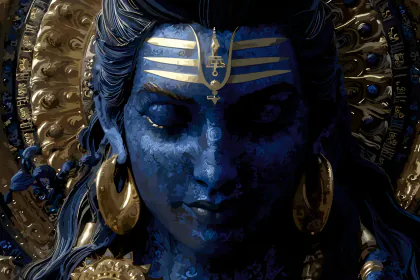 सोमान्तर
Somantara
The Moon Within
MonumentView →
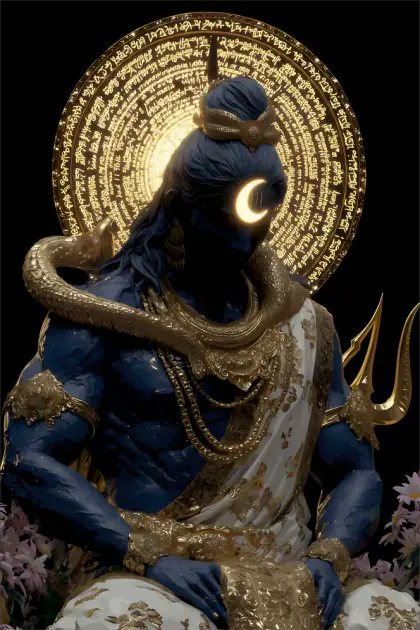 सोम शिव
Soma Shiva
The Moonlit Mind of Clarity
Icon & MonumentView →
This understanding has deeply influenced how I look at sacred art.
Consider Shivji in meditation.
His eyes are closed. His expression is effortless. There is a sense of infinite calmness, even when the artwork itself is monumental.
In Somantara and Soma Shiva, we explore different expressions of that stillness.
In Mahakaal, we encounter another dimension of Shivji, one that invites us to contemplate the immensity of time and the divine presence beyond it.
Each artwork offers a different perspective.
None can contain the entirety of Shivji.
And that is not what I believe art should attempt to do.
The divine does not need us to make it greater.
What we can do is create art that invites someone to experience a little of the greatness they already feel in its presence.
Perhaps someone standing before a depiction of Shivji will feel overwhelmed with joy.
Perhaps they will experience reverence.
Perhaps, as their attention settles on his expression, they will find their own thoughts becoming quieter.
And perhaps they will simply want to remain there for a little longer.
To look.
To experience.
To be present.
For a devotee, that moment may feel like an encounter with Shivji himself.
For another person, it may be a deeply moving experience of art and contemplation.
I believe there is room for both.
The Greatness We Continue to Discover
The more I try to understand Shivji, the more I realize how little I know.
And strangely, that realization does not feel discouraging.
It feels beautiful.
Because perhaps understanding the divine is not about arriving at one final explanation.
Perhaps it is about continuing to discover new dimensions of something that cannot be contained within a single understanding.
Shivji's strength, his compassion, his detachment, his stillness, his relationship with Shakti, his presence beyond time. Each invites us to look a little deeper.
And somewhere within that exploration, we may also discover something about ourselves.
I began writing this article wondering how someone as small as myself could describe the greatness of Mahadev.
I end it with the feeling that perhaps I was never meant to describe all of it.
Perhaps I was simply meant to keep discovering.
And to share a little of what I find along the way.
Explore the many expressions of Shivji through Ananta Devam's sacred artworks, where each creation offers an invitation to encounter the divine through art.